Author Archives: Citizens for Easton

DAN CRUSON LIVE!

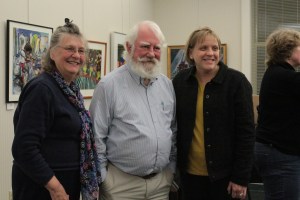
IMG_6088-6

Pictured: Dan Cruson with two former students- Mother and Daughter, Cheryl Andrews Smolinsky JB class of 1987, and Nancy Andrews JB class of 1962.

Photo credit: Katie Henry.

Image

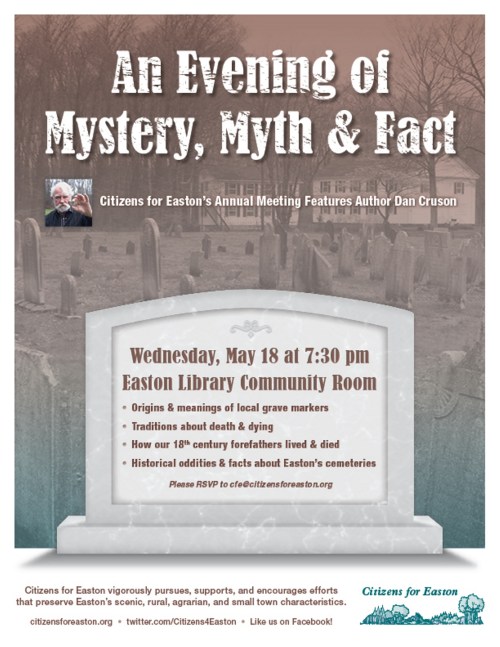
AN EVENING OF MYSTERY, MYTH & FACT

cruson flyer

Dan Cruson: Easton history revealed through its cemeteries Will be guest speaker at CFE’s annual meeting

CFE-speaker-Dan-Cruson

Dan Cruson, celebrated historian, scholar, writer and teacher, will be the guest speaker at CFE’s annual meeting,Wednesday, May 18, at 7:30 p.m. at the Easton Public Library.

Author of “Redding and Easton,” as well as many historical explorations of Newtown and environs, Cruson will “show and tell” many historical oddities and facts about Easton’s cemeteries.

As he has noted, “I’m always looking for things that people might not know.”

To that end, his presentation will unearth local cemeteries and reveal how our 18th century forefathers lived and died. He’ll explore the origins and meanings of local grave markers and traditions about death and dying. The evening will include a slide show and question and answer session.

Cruson will also sell and sign books. Refreshments will be served.

It promises to be an evening of mystery and myth … And perhaps the legend of the White Lady will be explained.


Please RSVP to cfe@citizensforeaston.org

JOIN US FOR AN EVENING OF MYSTERY, MYTH AND FACT!

Celebrated historian, scholar, writer and teacher, Dan Cruson will be the guest speaker at Citizens for Easton’s annual meeting, Wednesday, May 18 at 7:30 p.m. at the Easton Public Library. Dan is the author of Redding and Easton, as well as many historical explorations of Newtown and environs. At CFE’s annual celebration of Easton’s heritage, he will “show and tell” many historical oddities and facts about Easton’s cemeteries.

As Dan has noted, “I’m always looking for things that people might not know.” To that end, his presentation will unearth facts about local cemeteries and reveal how our 18th century forefathers lived and died. We’ll learn about the origins and meanings of local grave markers and traditions about death and dying. The evening will include a slide show and question and answer session. Dan will also sell and sign books. Come to meet and mingle with fellow CFE members and neighbors during this fascinating look below Easton’s surface into graves and buried secrets.

There will also be a dessert buffet. Please RSVP to cfe@citizensforeaston.org

WHITE LADY

Town and intervenor oppose Saddle Ridge’s appellate court petitions

Saddle Ridge Village. Easton Courier archives

Two town commissions and the Coalition to Save Easton have filed memos opposing Petitions for Certification to the appellate court by Saddle Ridge Development LLC, et al, to hear their case on appeal.

The memos cap a multi-year dispute over Saddle Ridge Development LLC’s proposal to build Saddle Ridge Village, a 99-unit townhouse development with affordable housing units on watershed land bordering Cedar Hill, Silver Hill, Sport Hill, and Westport roads.

The developer sued to overturn Easton’s land use commissions denials of the dense housing development, which was to be located on the 124.7-acre site, which drains into the Aspetuck and Easton reservoirs and provides drinking water to more than 400,000 Fairfield County residents.

The reservoirs are part of an interconnected system of reservoirs that serve Stratford, Bridgeport, Trumbull, Shelton, Monroe, Fairfield and Westport. During the summer months, they are also used to supplement water demands in New Canaan, Wilton, Ridgefield, Stamford and Greenwich.

A Petition for Certification is a request for the Appellate Court to hear the case on appeal. Appeals in land use cases are not automatic, according to attorney Ira Bloom of Berchem, Moses & Devlin of Westport, who represented the Planning and Zoning and Conservation commissions and filed the memos on their behalf.

Bloom sent the memos to the appellate court on March 2 and said that Attorney Jan Brooks, representing the Coalition to Save Easton, intervenor in the case, sent a memo opposing Saddle Ridge’s petitions the same day.

The legal wrangling follows Hartford Superior Court Judge Marshall K. Berger’s Jan. 25 decision to dismiss the appeals of Saddle Ridge Development LLC and Silver Sports LP against the Easton Planning and Zoning Commission and the Easton Conservation Commission.

Berger’s decision was based on the finding that the public drinking water watershed is an important public interest that merits strong protection.

The appellate court court may decide to hear one, two or none of neither of the cases and likely will will make a decision in one to four months.

“My experience is they can take a few months to make a decision,” Bloom said.

Citizens for Easton responds to Saddle Ridge appeal

A short trek into the woods on the shores of the Aspetuck Reservoir off Route 58 in Easton led to a striking scene of natural beauty. Photo by Chris Burns

Verne Gay, president of  Citizens for Easton, responded to petitions to the appellate court by Saddle Ridge Development LLC, et al, to hear their case on appeal to build Saddle Ridge Village, a 99-unit townhouse development with affordable housing units.

On Feb. 22 the developer filed two Petitions for Certification — one each for the P&Z case and wetlands case — requesting that the appellate court hear the case on appeal.

The developers had sued to overturn Easton’s land use commissions denials of the dense housing development, which was to be located in watershed land that drains into the Aspetuck and Easton reservoirs and provides drinking water to more than 400,000 Fairfield County residents.

Hartford Superior Court Judge Marshall Berger on Jan. 25 dismissed the affordable housing and inland wetlands appeals by Saddle Ridge Developers LLC, et al, following a multi-year dispute. The decision capped years of dissension over the proposal to build the development on a 124.7-acre site on watershed land bordering Cedar Hill, Silver Hill, Sport Hill, and Westport roads.

Berger cited protection of the watershed as the paramount concern in his decision to dismiss Saddle Ridge’s appeals. The Coalition to Save Easton, a sub-group of Citizens for Easton, was the environmental intervener in the case.

“High-density housing on the watershed is a bad idea,” Gay said. “It’s bad public policy. It’s bad for public health, and it’s a terrible precedent.”

The reservoirs are part of an interconnected system of reservoirs that serve Stratford, Bridgeport, Trumbull, Shelton, Monroe, Fairfield and Westport. During the summer months, they are also used to supplement water demands in New Canaan, Wilton, Ridgefield, Stamford and Greenwich.

“Water is a precious natural resource, and hardly an inexhaustible public resource, and a resource that must be safeguarded, as the good people of Flint, Mich. now realize,” Gay said.

“This is what animated Citizens for Easton from the very beginning, and continues to animate us and our members, a belief that this is our town, and this is a resource we all depend upon, and it is our right — and frankly our duty — to reject efforts that seek to undermine both.

“Hartford Superior Court Judge Marshall Berger produced a deeply thoughtful and tightly reasoned opinion on this issue, which we stand by, and which — I would submit — most people in Easton and people in surrounding towns who also depend on this watershed support.”

Huntley “Bucky” Stone, who owns Saddle Ridge Development LLC and Silver Sports LP along with partner Robert Carlson, said at the time of Berger’s decision that he would continue his fight to win his case.

“We recognize that this process is a marathon, not a sprint,” Stone told the Courier a day after learning the court’s decision. “We’re nowhere near ‘hitting the wall.’”

Appeals in land use cases are not automatic. The Appellate Court has to decide to hear it, according to attorney Ira Bloom of Berchem, Moses & Devlin of Westport. Bloom represented the Easton Planning and Zoning and Conservation commissions.

The commissions have 10 days to file memos opposing Saddle Ridge’s requests, and that is what Bloom is working on. After that, the Appellate Court will make a decision to accept the cases or not.  That decision usually takes a few months, Bloom said.

Gay said Citizens for Easton and the Coalition to Save Easton welcome the challenge.

“It’s important that Judge Berger’s ruling be upheld, and important that this precedent be set,” he said. “I believe representatives for Saddle Ridge, in filing the appeal, also suggested that this battle is a ‘marathon,’ and that they have no intention of stopping. Citizens for Easton doesn’t either. But even marathons come to an end, and we look forward to seeing this through to the finish line, too.”

VICTORY FOR SAFE DRINKING WATER: HOUSING DEVELOPMENT PROPOSAL DENIED

On January 25, 2016, Hartford Superior Court Judge Marshall Berger dismissed the affordable housing and inland wetlands appeals by Saddle Ridge Developers, LLC, et al, following a multi-year dispute. The developers had sued to overturn the town of Easton’s land use commissions denials of a proposed 99-unit townhouse development, which was to be located in watershed land that drains into the Aspetuck and Easton Reservoirs and provides drinking water to over 400,000 Fairfield County residents.


Watershed issues were paramount in reaching the decision to dismiss the appeals, according to Judge Berger’s memorandum of decision. “The preservation and protection of the wetlands and watercourses from random, unnecessary, undesirable and unregulated uses, disturbance or destruction is in the public interest and is essential to the health, welfare and safety of the citizens of the state,” the document reads.


Critics of the development project were elated at the court’s decision. “The Saddle Ridge proposal would set a terrible precedent for building on watershed land,” said Verne Gay, President of Citizens for Easton (CFE) and a member of the Coalition to Save Easton, (CSE) a sub-group of CFE that was the environmental intervener in the case.” Gay added, “I’m so grateful to Judge Berger for being so thorough and fair.”


In accordance with the Connecticut State Legislature’s directions to protect the town’s watersheds, the town’s land use commissions “properly reviewed the impact of Saddle Ridge’s proposal and denied the applications,” the memorandum reads. “The commission has proven that it’s decision was necessary to protect the public’s interest in safe drinking water that the risk to the drinking water supply for 400,000 people clearly outweighed the need for affordable housing units as proposed by Saddle Ridge.” Saddle Ridge Developers, LLC had planned to build 30 units to meet the criteria of State Statute 8-30g. CFE/CSE also notes that the existing affordable units on record with the town of Easton have historically had a vacancy rate of approximately 50%.

Watershed protection paramount in Saddle Ridge decision

Developer evaluating judge’s decision and options

Saddle Ridge Village. Easton Courier archives

Town officials have reacted positively to the Jan. 25 court decision to dismiss the appeals of Saddle Ridge Development LLC and Silver Sports LP against the Easton Planning and Zoning Commission and the Easton Conservation Commission.

The decision capped years of dissension over a proposal to build Saddle Ridge Village, a nearly 100-unit development with affordable housing units on a 124.7-acre site on watershed land bordering Cedar Hill, Silver Hill, Sport Hill, and Westport roads.

But the court decision may not mark the end of the proceedings.

The developer has 20 days to request the appellate court to hear the case on appeal, attorney Ira Bloom of Berchem, Moses & Devlin of Westport said. Bloom represented the Planning and Zoning and Conservation commissions.

And Huntley “Bucky” Stone, who owns Saddle Ridge Development LLC and Silver Sports LP along with partner Robert Carlson, appears to be continuing his fight to win his case.

“We recognize that this process is a marathon, not a sprint,” Stone said on Jan. 26. “We’re nowhere near ‘hitting the wall.’”

Hunt said the court decision “was no surprise. It was my prediction. It’s the safe way of going.”

Critics of the development project were jubilant over the court decision.

“Everybody’s thrilled,” said Verne Gay, president of Citizens for Easton and a member of the Coalition to Save Easton, a sub-group of CFE that was an environmental intervener in the case. “It was the best possible news and outcome.”

The group made the effort to stop Saddle Ridge because building the development “would set a terrible precedent for building on watershed land,” Gay said, and would run contrary to the town’s agrarian character.

“It was a bad idea,” he said. “I’m so grateful to Judge Berger for being so thorough and fair.”

In fact, watershed issues were paramount in reaching the decision to dismiss the appeals, according to the memorandum of decision.

“The preservation and protection of the wetlands and watercourses from random, unnecessary, undesirable and unregulated uses, disturbance or destruction is in the public interest and is essential to the health, welfare and safety of the citizens of the state,” the document reads.

In accordance with the state legislature’s directions to protect the town’s watersheds, the town’s land use commissions “properly reviewed the impact of Saddle Ridge’s proposal and denied the applications,” the memorandum reads.

First Selectman Adam Dunsby said the court “made a well-reasoned decision affirming the Easton Planning and Zoning Commission and the Easton Conservation Commission’s determination that the public drinking water watershed is an important public interest that merits the strongest protection.”

Bloom said he was “very pleased” about the court decision.

“I thought the decision was very thorough and complete and cited much of the evidence that the commissions relied upon in making their decisions,” Bloom said. “Both commissions should be commended for their extensive work on these cases. They did a very good job.”

The judge consolidated the developer’s two appeals — to the Conservation Commission on wetlands issues and to P&Z on the affordable housing piece — this past September, Bloom said.

A Sept. 8 court hearing followed fruitless settlement talks and rejection by the P&Z Commission in January 2015 of Easton Crossing, the developers’ alternative proposal.

The density of the Saddle Ridge proposal exceeded what was recommended by the state for development in a watershed — one unit per two buildable acres

— according to Bloom’s brief for the P&Z at the hearing.

Attorney Matthew Ranelli of Shipman & Goodwin of Hartford represents the developers.

Ranelli said the Easton Crossing 48-unit housing development with affordable accessory apartments was an attempt to find a solution with the P&Z, but resolution wasn’t reached.

Ranelli said he couldn’t comment at length about the Jan. 25 court decision because his general policy is not to comment when cases are still pending.

“We’re evaluating the decision and our options,” he said.

Stone said he and Carlson are “digesting” the 57-page memorandum of decision.

“We take it very seriously,” he said

SADDLE RIDGE -DISMISSED

Citizens for Easton is pleased to announce a victory in the decision of the Saddle Ridge court case yesterday. Hartford Superior Court Judge Marshall Berger, citing the Connecticut State Legislature’s directives to preserve and protect the water resources of the State, has wisely dismissed Saddle Ridge Developers, LLC appeals against the Easton Planning and Zoning Commission and Conservation Commission’s decisions.


This decision will aid in protecting the public drinking water supply for the more than 400,000 state residents, who depend daily  on the water’s safety and potability.


With your crucial support, the Coalition to Save Easton was able to intervene in this legal matter to protect the watershed, the public drinking water supply, and the zoning which was enacted to protect both.


On behalf of the board of Citizens for Easton, thank you!

Partnership would preserve Gilbertie property Land and greenhouses would be protected for open space and farming

Dan Levinson, president of Main Street Resources, and Sal Gilbertie shake hands to seal their business deal.

A third-generation farmer, Sal Gilbertie gets up every morning and goes to work all day in his four acres of greenhouses on Adams Road. He grows petite edibles, cut greens and other USDA-certified organic products to sell to leading food markets in the tri-state area.

He and his family own and operate Gilbertie’s Herbs and Garden Center in Westport, begun by his grandfather, in addition to farming the wholesale operation in Easton.

Farming is what Gilbertie loves, and at 79, he shows no signs of slowing down or wanting to do anything else.

“I hope I can keep doing it all my life,” he said at the end of a busy workday.

But farming has challenges beyond dawn-to-dusk hard work and the whims of Mother Nature.

Three years ago, financial reality forced him to sell the 34-acre property on Adams and Keller roads that he and his wife, Marie, purchased in 1984. Dan Levinson, president of Main Street Resources, a limited liability company in Westport, bought it. Gilbertie continues to operate his business through a lease with Levinson.

Levinson and David Brant, executive director of the Aspetuck Land Trust, want to create a conservation easement that would preserve 15.4 acres of the property as open space and have approached the town of Easton about forming a partnership.

The site abuts Randall’s Farm Preserve, the 34-acre former farm that Joan DuPont donated to the land trust three years ago.

Brant and Ross Ogden, a Planning and Zoning Commission alternate, presented a broad overview of the proposed partnership to the Board of Selectmen, subject to negotiations and taxpayer approval.

The other half of the property, with its working greenhouses and buildings, plus the house, which sits on three acres, would continue to be a farm.

Brant said the proposed venture would be “a nice extension” to the 34 acres Joan Dupont donated, and that the land trust “would work very hard to come to some kind of a deal.”

“We love Easton, which has a great agricultural heritage and ongoing agricultural enterprises,” Brant said. “Preventing Gilbertie’s farm from being developed is a good thing. It’s fortunate that Dan has the means and inclination to preserve it as an agricultural enterprise.”

Sport Hill Farm also grows vegetables on the site, Brant said.

With regard to the 14 acres that would be preserved as open space, Brant said the land trust would undertake fund raising to come up with the money to purchase it, if the town is able to be a partner.

“We’d like to see Gilbertie’s Farm preserved, and we’re going to try to make it happen,” First Selectman Adam Dunsby said.

The town has a fund for fees in lieu of open space that can be used only for open space purchases. People who come before the Planning and Zoning Commission for subdivision approvals have the choice of donating 15% of the land they are developing or the cash equivalent. Over the years the fund has accrued $806,916.

Two other funds might be able to be tapped for money for this purpose, the agriculture land preservation fund, which has $66,595 and the land acquisition fund, which has $8,752.

“So the town is in the rare position of actually having money that could be used for this purpose as I understand it,” Dunsby said. “If the town participated, there would be no tax impact. We would be drawing on existing funds.”

Since the partnership involves a purchase, it would require a referral to the Planning and Zoning Commission, meetings with the Board of Finance and a Town Meeting. Nothing is set in stone since the idea is in the conceptual stage, subject to negotiations, but the parties are anxious to move it forward.

“We purchased the property from Sal three years ago to protect it and are hoping to work with the land trust, the town and Sal to put a transaction together that protects the farm long-term for the community,” Levinson said. “We would love to keep it as an operating farm and protect it from rising prices and fear of future development.”

Levinson said Easton is one of the few parts of the world that has a shot at preserving small, working farms, “preserving something really beautiful.”

“We believe that the local food system is really critical in New England, and places like Gilbertie’s can play a critical role in bringing local farming back to life,” Levinson said.

He is cofounder to the Green Village Initiative, a nonprofit in Bridgeport, whose mission is to create social, economic and environmental change through a network of ,  and . The initiative promotes and educates the community about nutrition, healthy eating, agriculture, and gardening in an urban setting.

“We have a strong interest to get something done in the town’s and land trust’s interest, as we set out to protect the farm,” Levinson said.

Gilbertie said he just had his best quarter selling petite edibles and is excited about the prospect of working with Brant and Levinson, whom he considers friends, and the town to preserve the farming legacy in Easton.

A renowned expert on herbs and vegetables,Gilbertie has written half a dozen books, available on Amazon.com, and appeared on the Martha Stewart Show.

Stewart had this to say about Gilbertie’s fifth book, Small-Plot, High-Yield Gardening: “Whether you have a real garden or just a window box, I can think of no better guide to creating a sustainable herb and vegetable garden than Sal Gilbertie,” she said. “For more than 30 years I have turned to Sal for healthy, productive plants. With this useful and informative book, he can help you, too, cultivate your garden.”