Category Archives: Preserving Easton

Image

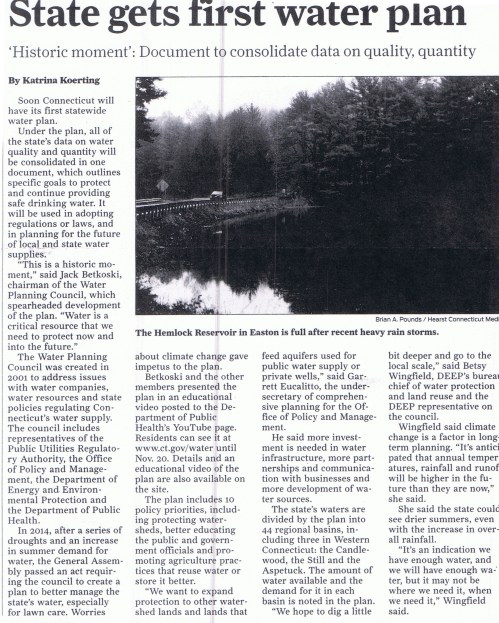
STATE WATER PLAN ARTICLE FROM FAIRFIELD CITIZEN

Saddle Ridge legal challenges proceed through courts

The proposed development plan for the 124-acre Saddle Ridge property, which would include single-family homes and duplex units, with 30% of them to be designated as affordable housing.

Legal challenges to the approved Saddle Ridge housing development are slowly working their way through the courts, with no clear indication when written briefs might be filed or oral arguments will take place.

The Planning and Zoning Commission’s unanimous vote in March is being appealed by entities that both favor and oppose the controversial plan, which would have 20 affordable housing units out of 66 total units.

The developer, consisting of Saddle Ridge Developers LLC and Silver Sport Associates LP, is upset with some of the many conditions — or restrictions — put on the project’s approval by the P&Z. The Coalition to Save Easton, a group affiliated with the Citizens For Easton organization that has long focused on retaining the town’s rural character, wants the P&Z decision overturned.

The two lawsuits have been consolidated by the court and transferred to the state’s Superior Court land-use docket, and will be heard by Judge Marshall Berger. In a previous lawsuit involving a different development proposal by the Saddle Ridge developer at the same site, Berger denied the developer’s appeal and ruled in favor of the P&Z’s rejection of that project.

A conference call on the pending case for representatives of the participating parties has been scheduled for Oct. 3. A previous conference call took place Aug. 22.

The P&Z is being represented by attorney Ira Bloom of the Berchem Moses firm, who handles many matters for the town; the developer’s attorney is Matthew Ranelli of Shipman & Goodwin; and the coalition’s legal representative is attorney Janet P. Brooks, an environmental specialist.

Bloom said the judge has asked lawyers involved in the case to report in about once a month on their status in the litigation.

In the future, the attorneys will be given a date to submit written briefs by the judge and then a date set to hear oral arguments. “But that’s a ways down the road,” Bloom said.

Ranelli, the developer’s attorney, said he could offer no comment at this time. Ranelli also represented the developer in front of the P&Z during the application process.

Brooks, the Coalition to Save Easton’s lawyer, could not be reached for comment.

William J. Kupinse Jr., one of three interveners in the case on behalf of the coalition, said the case remains in “its preliminary stages. Like most litigation, it will drag along for awhile and eventually be heard by the court.”

Kupinse, a former Easton first selectman, is a practicing attorney but is not involved in this case as a legal representative, but as a town resident on behalf of the coalition. The two other coalition members listed in court papers are Leslie Minasi and Verne Gay.

The P&Z has met to discuss the legal case in executive session — which are closed to the public and media — several times before regular meetings in recent months.

P&Z Chairman Robert Maquat said he doesn’t believe any formal legal documents other than the original lawsuit papers — called “complaints” in legal jargon — have been filed with the court. “We’re kind of in a holding pattern,” Maquat said.

The project, the appeals

As approved, Saddle Ridge would have 30 single-family homes as well as 18 duplex structures with an additional 36 living units. All structures would be on lots of at least one acre, with about one-third of the overall site kept as homeowners’ association-owned open space. Each of the 48 lots would be served by individual septic systems and wells.

The development, known as Easton Crossing, would be built on a 110-acre site that had been zoned for three-acre, single-family houses.

The application was filed under the state’s affordable housing law, known as statute 8-30g, which puts an extra burden on local land-use boards when rejecting an application.

In its appeal, the developer claims the P&Z’s numerous conditions of approval “essentially denies Saddle Ridge’s application because it will have a substantial adverse impact on the viability and degree of affordability of Saddle Ridge’s development.”

The appeal states the P&Z’s 77 conditions “do not clearly outweigh the need for affordable housing in Easton” and “could have been addressed by reasonable changes to the application plans.”

The Coalition to Save Easton, in its lawsuit, questions having have one septic system for each two-unit duplex structure based on a town ordinance, the P&Z concluding a new inland wetlands application wasn’t needed, and if the project’s regional environmental impact was fully vetted.

 

In addition to the above article published in the Easton Courier, the project is reasonably likely to have the effect of unreasonable polluting the waters  of the State as concluded by our experts,.  And, as partially stated in the last paragraph in the Courier article, the project contains community septic, which is contrary to Town Ordinance. Also, among our other concerns, the application bypassed the Conservation Commission usurping their role in determining the licensing of regulated activities .

CITIZENS FOR EASTON – LAST YEAR’S FUN FARM TOUR HIGHLIGHTS

Paris Climate Accord withdrawal sparks local activism

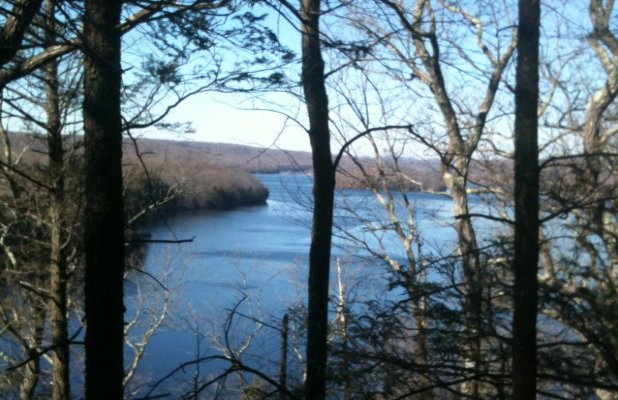
A view of the Saugatuck Reservoir from Popp Mountain in Trout Brook Valley in Easton. — Photo courtesy of Aspetuck Land Trust

By Susan Hunter on July 3, 2017 in the Easton Courier

President Donald Trump’s June 1 announcement that the United States is withdrawing from the Paris Climate Accord has spawned reactions from environmental activists on local, state and national levels. The resounding message locally is that work to combat climate change and threats to the environment is stronger than ever in Easton and other communities.
Verne Gay, president of Citizens for Easton (CFE), terms Trump’s decision “a spectacular disappointment. It’s frustrating for people like me, people who are community activists interested in environmental issues,” he said,
CFE’s goal is to preserve the town’s rural and natural character.
The federal government is “ceding moral leadership,” Gay said, and local communities “have to be the one to take the lead. It means everyone has to double down and be more dedicated. If the country is going to cede that position, it’s more incumbent on communities and individuals to step into the breach. You lead from the bottom up.” Gay referred to the familiar phrase, “Think globally, act locally” to sum up his feelings.

Continue reading

Your support is urgently needed to protect the watershed. Click here for more information.

More signs of spring in Easton… Call for photos!

– Photo courtesy of Katie Henry

Please send any photos that celebrate Easton’s scenic, rural agrarian and small town characteristics to cfe@citizensforeaston.org with a note in the subject line: “Photo Submission.” Periodically, we hope to randomly select images to post on our website. If you’d like your name to be credited, kindly note that also. Thank you in advance!

Easton P&Z approves high density affordable housing development on sensitive watershed property draining into two major reservoirs

Our zoning commission has approved the application for an intensive affordable housing development proposed by Saddle Ridge, “with multiple conditions.” No matter the conditions, the intensive development of this property in the watershed between two reservoirs which service over 400,000 residents in Fairfield County should not have been approved. Aquarian Water Company opposed the application, as well as various town officials and governmental entities. In a prior application by Saddle Ridge our courts previously recognized that the need to protect the watershed outweighed the need for an intensive affordable housing development by Saddle Ridge. Continue reading

NEXT (AND MAYBE LAST) SADDLE RIDGE PUBLIC HEARING

Adequate water supplies of high quality are
necessary both for community use and local
ecosystems . . .

Citizens for Easton feel the development proposed by Saddle Ridge would be a danger to our drinking water.

But…we can’t do it alone

Attendance is critical: Thursday, Dec 22 7:00 PM HKMS


Citizens for Easton relies on donations

Click HERE to donate via PayPal and add instruction “CSE” or send your checks made out to Citizens for Easton with Coalition to Save Easton (CSE) in the memo, and mail to Citizens for Easton, PO Box 151, Easton, CT 06612. CSE is a division of CFE which is a registered 501 (c) (3) tax-exempt organization. With your support we can continue to hire experts to help in our efforts to protect and preserve our water supply.

Please contact

Rob Maquat, Planning & Zoning Chairman via email at manania@eastonct.gov and Dori Wollen, Conservation Commission Chairperson at kring@eastonct.gov, or send a letter to them at 225 Center Road, Easton, CT 06612.

Thank you  for your passion, support and dedication to something that affects every one of us – the environment and the future of our town. Citizens for Easton/CSE will continue to advocate to uphold Easton’s zoning and to protect the safety of the public drinking water supply.

NEW SADDLE RIDGE THREAT TO WATERSHED

Droughts have a way of focusing our attention here in Easton. Lawns dry out, leaves too. Empty streambeds wind through dessicated woods enroute to reservoirs that slowly, then quickly, recede to regain a widening shoreline. What happens below ground is even more dramatic: Water tables drop, well levels too, and slowly, that which we take for granted  begins to assert an ominous hypothetical: What if water is no longer there to take for granted?

Easton is a water town — it has been our heritage and now, our destiny. Without the need for water, Easton might not even exist, or certainly not in the unique form of today. Reservoirs and the watersheds that sustain them have shaped our character for well over a century, but those watersheds sustain far more than just those: They sustain us.

This drought — hopefully relieved by rain — does at least offer another opportunity to remind ourselves why precious — and not automatically renewable — resources like water matter so much. By protecting this resource, we protect Easton’s county-wide mandate to provide a clean and steady supply of water. By protecting this, we ensure that  the next generation has a viable template  for conservation too. But most of all, by protecting this we ensure the health of our families, and our children.

As you are perhaps aware, there is yet another Saddle Ridge application before Planning and Zoning that seeks to build a cluster housing development on watershed land. Citizens for Easton has previously and successfully fought this assault on our health and on our water, and be assured, CFE will oppose this application as well.

We hope all Eastonites understand the vital importance of protecting a resource we can no longer take for granted. The health and well-being of our children, and their children, depend on it.

Verne Gay

Board Chairman

Citizens for Easton

Connecticut Audubon Society supports preservation of South Park Avenue property

Following is text of the letter from the Executive Director of the Connecticut Audubon Society to the Easton Board of Selectmen:
The Connecticut Audubon Society joins with Citizens for Easton in its concern about the future of 29.6 acres on South Park Avenue adjacent to the Mill River. Development of this town-owned land will compromise a small but beautiful wildlife habitat that plays an important watershed protection role for the river, and is a much-used and enjoyed passive outdoor recreational area for birdwatchers, anglers, artists and school groups.
The Mill River is one of only nine Class A Wild Trout Streams left in Connecticut and is unique because it is pristine and cold enough to sustain wild trout despite being on the edge of a suburban area. Wild brook and brown trout are among 17 fish species listed as “most important” in the Connecticut Wildlife Action Plan.
Preserving the property would also be consistent with Easton’s Town Plan of Conservation and Development, which states as its “cardinal principle”: “The major policies and goals of the Town Plan in respect to resource conservation are: Protect the natural, scenic, historical and cultural resources of the town, especially its wetlands, streambelts and ground water resources, but also its steep slopes, ridgelines, major trees and significant wildlife areas …”
The Connecticut Audubon Society is the state’s original, independent Audubon. We and our many members in Easton look forward to your leadership as exemplary stewards of the environment by supporting the preservation the 29.6 acres on South Park Avenue as open space in perpetuity for current and future generations.
Sincerely,
Nelson North
Executive Director