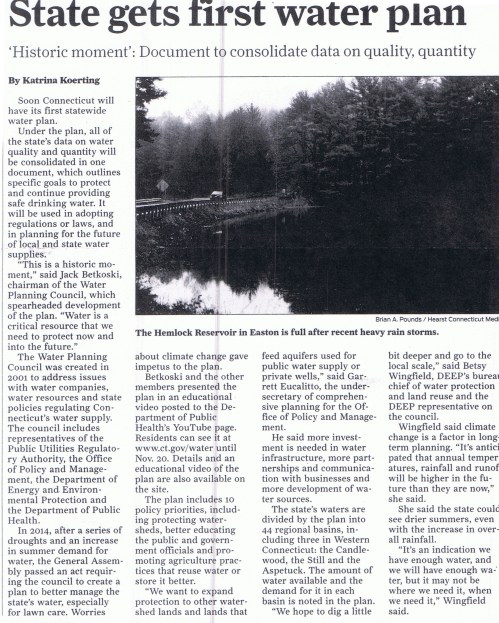
(HARTFORD, CT) – Governor Dannel P. Malloy today signed an executive order directing the state’s Water Planning Council (WPC) to immediately implement the State Water Plan that was submitted to the Connecticut General Assembly in January 2018.
The plan, which was ordered by the General Assembly through Public Act 14-163, was developed by the WPC to balance the needs of public water supply, economic development, recreation, and ecological health. It was completed through an exhaustive and transparent process that included an extended period of public comment from all stakeholders. The plan required legislative review and approval, but the legislative session ended without action from the General Assembly.
A major point of contention for some legislators was a provision in the State Water Plan’s executive summary that declares water a public trust – a declaration of public policy that has been enshrined in state statute for more than 40 years. The Governor’s executive order recommits to the definition of water as a public trust.
“The State Water Plan is a critically important initiative that puts the needs of Connecticut families ahead of the commercial interests of private water utility companies and big businesses,” Governor Malloy said. “We should all be able to agree that water is a precious resource that should be protected for the public’s interest and safeguarded for future generations in the event of emergencies. Today’s executive order does just that, ensuring that we waste no time safeguarding our clean water supply.”
In addition to implementing the State Water Plan, the executive order takes the following actions:
- Directs the WPC to coordinate and work with the advisory group established pursuant to Section 25-33o(c) to help implement the State Water Plan.
- Orders the WPC to resubmit the State Water Plan to the General Assembly for its review and approval by December 1.
“Connecticut’s water resources are among the purest and most well protected in the nation, and the State Water Plan ensures that this public trust resource will be wisely stewarded for future generations,” Department of Energy and Environmental Protection Commissioner Rob Klee said. “This plan, developed through a consensus-based stakeholder process, provides the data and guidance needed for our state to make informed choices in managing this precious resource.”
“The preservation, management and use of water is critical to Connecticut’s future,” Department of Public Health Commissioner Dr. Raul Pino said. “I thank the Governor for championing this important, multi-year plan that is designed to ensure a balanced use of this most precious natural resource, and we look forward to working with the administration, the legislature and the other members of the Water Planning Council to enact the State Water Plan.”
“Public Trust is a policy that recognizes the public’s inherent right to clean air, clean water, and a healthy environment,” Alicea Charamut of Connecticut River Conservancy said. “Here in Connecticut, we are fortunate to have this public trust policy solidified in statute – a statute that has been in place for 40 years. But those who profit from our water resources consider this policy a threat to their bottom line and seek to undermine its principal. They claim its inclusion in Connecticut’s State Water Plan as it currently resides will introduce uncertainty and confusion. To the contrary, honoring Connecticut’s public trust policy will ensure that we have clean and adequate water for public health, the environment, recreation and the economy for generations to come.”
The WPC is comprised of representatives four agencies: the Department of Energy and Environmental Protection, the Department of Public Health, the Office of Policy and Management and Public Utilities Regulatory Authority.
The State Water Plan is the first of its kind in Connecticut.









 Citizens For Easton