Category Archives: Saddle Ridge

Town and intervenor oppose Saddle Ridge’s appellate court petitions

Saddle Ridge Village. Easton Courier archives

Two town commissions and the Coalition to Save Easton have filed memos opposing Petitions for Certification to the appellate court by Saddle Ridge Development LLC, et al, to hear their case on appeal.

The memos cap a multi-year dispute over Saddle Ridge Development LLC’s proposal to build Saddle Ridge Village, a 99-unit townhouse development with affordable housing units on watershed land bordering Cedar Hill, Silver Hill, Sport Hill, and Westport roads.

The developer sued to overturn Easton’s land use commissions denials of the dense housing development, which was to be located on the 124.7-acre site, which drains into the Aspetuck and Easton reservoirs and provides drinking water to more than 400,000 Fairfield County residents.

The reservoirs are part of an interconnected system of reservoirs that serve Stratford, Bridgeport, Trumbull, Shelton, Monroe, Fairfield and Westport. During the summer months, they are also used to supplement water demands in New Canaan, Wilton, Ridgefield, Stamford and Greenwich.

A Petition for Certification is a request for the Appellate Court to hear the case on appeal. Appeals in land use cases are not automatic, according to attorney Ira Bloom of Berchem, Moses & Devlin of Westport, who represented the Planning and Zoning and Conservation commissions and filed the memos on their behalf.

Bloom sent the memos to the appellate court on March 2 and said that Attorney Jan Brooks, representing the Coalition to Save Easton, intervenor in the case, sent a memo opposing Saddle Ridge’s petitions the same day.

The legal wrangling follows Hartford Superior Court Judge Marshall K. Berger’s Jan. 25 decision to dismiss the appeals of Saddle Ridge Development LLC and Silver Sports LP against the Easton Planning and Zoning Commission and the Easton Conservation Commission.

Berger’s decision was based on the finding that the public drinking water watershed is an important public interest that merits strong protection.

The appellate court court may decide to hear one, two or none of neither of the cases and likely will will make a decision in one to four months.

“My experience is they can take a few months to make a decision,” Bloom said.

Citizens for Easton responds to Saddle Ridge appeal

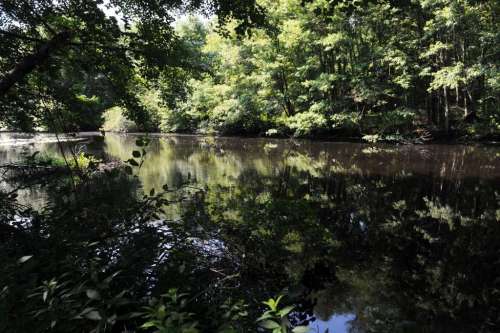
A short trek into the woods on the shores of the Aspetuck Reservoir off Route 58 in Easton led to a striking scene of natural beauty. Photo by Chris Burns

Verne Gay, president of  Citizens for Easton, responded to petitions to the appellate court by Saddle Ridge Development LLC, et al, to hear their case on appeal to build Saddle Ridge Village, a 99-unit townhouse development with affordable housing units.

On Feb. 22 the developer filed two Petitions for Certification — one each for the P&Z case and wetlands case — requesting that the appellate court hear the case on appeal.

The developers had sued to overturn Easton’s land use commissions denials of the dense housing development, which was to be located in watershed land that drains into the Aspetuck and Easton reservoirs and provides drinking water to more than 400,000 Fairfield County residents.

Hartford Superior Court Judge Marshall Berger on Jan. 25 dismissed the affordable housing and inland wetlands appeals by Saddle Ridge Developers LLC, et al, following a multi-year dispute. The decision capped years of dissension over the proposal to build the development on a 124.7-acre site on watershed land bordering Cedar Hill, Silver Hill, Sport Hill, and Westport roads.

Berger cited protection of the watershed as the paramount concern in his decision to dismiss Saddle Ridge’s appeals. The Coalition to Save Easton, a sub-group of Citizens for Easton, was the environmental intervener in the case.

“High-density housing on the watershed is a bad idea,” Gay said. “It’s bad public policy. It’s bad for public health, and it’s a terrible precedent.”

The reservoirs are part of an interconnected system of reservoirs that serve Stratford, Bridgeport, Trumbull, Shelton, Monroe, Fairfield and Westport. During the summer months, they are also used to supplement water demands in New Canaan, Wilton, Ridgefield, Stamford and Greenwich.

“Water is a precious natural resource, and hardly an inexhaustible public resource, and a resource that must be safeguarded, as the good people of Flint, Mich. now realize,” Gay said.

“This is what animated Citizens for Easton from the very beginning, and continues to animate us and our members, a belief that this is our town, and this is a resource we all depend upon, and it is our right — and frankly our duty — to reject efforts that seek to undermine both.

“Hartford Superior Court Judge Marshall Berger produced a deeply thoughtful and tightly reasoned opinion on this issue, which we stand by, and which — I would submit — most people in Easton and people in surrounding towns who also depend on this watershed support.”

Huntley “Bucky” Stone, who owns Saddle Ridge Development LLC and Silver Sports LP along with partner Robert Carlson, said at the time of Berger’s decision that he would continue his fight to win his case.

“We recognize that this process is a marathon, not a sprint,” Stone told the Courier a day after learning the court’s decision. “We’re nowhere near ‘hitting the wall.’”

Appeals in land use cases are not automatic. The Appellate Court has to decide to hear it, according to attorney Ira Bloom of Berchem, Moses & Devlin of Westport. Bloom represented the Easton Planning and Zoning and Conservation commissions.

The commissions have 10 days to file memos opposing Saddle Ridge’s requests, and that is what Bloom is working on. After that, the Appellate Court will make a decision to accept the cases or not.  That decision usually takes a few months, Bloom said.

Gay said Citizens for Easton and the Coalition to Save Easton welcome the challenge.

“It’s important that Judge Berger’s ruling be upheld, and important that this precedent be set,” he said. “I believe representatives for Saddle Ridge, in filing the appeal, also suggested that this battle is a ‘marathon,’ and that they have no intention of stopping. Citizens for Easton doesn’t either. But even marathons come to an end, and we look forward to seeing this through to the finish line, too.”

VICTORY FOR SAFE DRINKING WATER: HOUSING DEVELOPMENT PROPOSAL DENIED

On January 25, 2016, Hartford Superior Court Judge Marshall Berger dismissed the affordable housing and inland wetlands appeals by Saddle Ridge Developers, LLC, et al, following a multi-year dispute. The developers had sued to overturn the town of Easton’s land use commissions denials of a proposed 99-unit townhouse development, which was to be located in watershed land that drains into the Aspetuck and Easton Reservoirs and provides drinking water to over 400,000 Fairfield County residents.


Watershed issues were paramount in reaching the decision to dismiss the appeals, according to Judge Berger’s memorandum of decision. “The preservation and protection of the wetlands and watercourses from random, unnecessary, undesirable and unregulated uses, disturbance or destruction is in the public interest and is essential to the health, welfare and safety of the citizens of the state,” the document reads.


Critics of the development project were elated at the court’s decision. “The Saddle Ridge proposal would set a terrible precedent for building on watershed land,” said Verne Gay, President of Citizens for Easton (CFE) and a member of the Coalition to Save Easton, (CSE) a sub-group of CFE that was the environmental intervener in the case.” Gay added, “I’m so grateful to Judge Berger for being so thorough and fair.”


In accordance with the Connecticut State Legislature’s directions to protect the town’s watersheds, the town’s land use commissions “properly reviewed the impact of Saddle Ridge’s proposal and denied the applications,” the memorandum reads. “The commission has proven that it’s decision was necessary to protect the public’s interest in safe drinking water that the risk to the drinking water supply for 400,000 people clearly outweighed the need for affordable housing units as proposed by Saddle Ridge.” Saddle Ridge Developers, LLC had planned to build 30 units to meet the criteria of State Statute 8-30g. CFE/CSE also notes that the existing affordable units on record with the town of Easton have historically had a vacancy rate of approximately 50%.

Watershed protection paramount in Saddle Ridge decision

Developer evaluating judge’s decision and options

Saddle Ridge Village. Easton Courier archives

Town officials have reacted positively to the Jan. 25 court decision to dismiss the appeals of Saddle Ridge Development LLC and Silver Sports LP against the Easton Planning and Zoning Commission and the Easton Conservation Commission.

The decision capped years of dissension over a proposal to build Saddle Ridge Village, a nearly 100-unit development with affordable housing units on a 124.7-acre site on watershed land bordering Cedar Hill, Silver Hill, Sport Hill, and Westport roads.

But the court decision may not mark the end of the proceedings.

The developer has 20 days to request the appellate court to hear the case on appeal, attorney Ira Bloom of Berchem, Moses & Devlin of Westport said. Bloom represented the Planning and Zoning and Conservation commissions.

And Huntley “Bucky” Stone, who owns Saddle Ridge Development LLC and Silver Sports LP along with partner Robert Carlson, appears to be continuing his fight to win his case.

“We recognize that this process is a marathon, not a sprint,” Stone said on Jan. 26. “We’re nowhere near ‘hitting the wall.’”

Hunt said the court decision “was no surprise. It was my prediction. It’s the safe way of going.”

Critics of the development project were jubilant over the court decision.

“Everybody’s thrilled,” said Verne Gay, president of Citizens for Easton and a member of the Coalition to Save Easton, a sub-group of CFE that was an environmental intervener in the case. “It was the best possible news and outcome.”

The group made the effort to stop Saddle Ridge because building the development “would set a terrible precedent for building on watershed land,” Gay said, and would run contrary to the town’s agrarian character.

“It was a bad idea,” he said. “I’m so grateful to Judge Berger for being so thorough and fair.”

In fact, watershed issues were paramount in reaching the decision to dismiss the appeals, according to the memorandum of decision.

“The preservation and protection of the wetlands and watercourses from random, unnecessary, undesirable and unregulated uses, disturbance or destruction is in the public interest and is essential to the health, welfare and safety of the citizens of the state,” the document reads.

In accordance with the state legislature’s directions to protect the town’s watersheds, the town’s land use commissions “properly reviewed the impact of Saddle Ridge’s proposal and denied the applications,” the memorandum reads.

First Selectman Adam Dunsby said the court “made a well-reasoned decision affirming the Easton Planning and Zoning Commission and the Easton Conservation Commission’s determination that the public drinking water watershed is an important public interest that merits the strongest protection.”

Bloom said he was “very pleased” about the court decision.

“I thought the decision was very thorough and complete and cited much of the evidence that the commissions relied upon in making their decisions,” Bloom said. “Both commissions should be commended for their extensive work on these cases. They did a very good job.”

The judge consolidated the developer’s two appeals — to the Conservation Commission on wetlands issues and to P&Z on the affordable housing piece — this past September, Bloom said.

A Sept. 8 court hearing followed fruitless settlement talks and rejection by the P&Z Commission in January 2015 of Easton Crossing, the developers’ alternative proposal.

The density of the Saddle Ridge proposal exceeded what was recommended by the state for development in a watershed — one unit per two buildable acres

— according to Bloom’s brief for the P&Z at the hearing.

Attorney Matthew Ranelli of Shipman & Goodwin of Hartford represents the developers.

Ranelli said the Easton Crossing 48-unit housing development with affordable accessory apartments was an attempt to find a solution with the P&Z, but resolution wasn’t reached.

Ranelli said he couldn’t comment at length about the Jan. 25 court decision because his general policy is not to comment when cases are still pending.

“We’re evaluating the decision and our options,” he said.

Stone said he and Carlson are “digesting” the 57-page memorandum of decision.

“We take it very seriously,” he said

SADDLE RIDGE -DISMISSED

Citizens for Easton is pleased to announce a victory in the decision of the Saddle Ridge court case yesterday. Hartford Superior Court Judge Marshall Berger, citing the Connecticut State Legislature’s directives to preserve and protect the water resources of the State, has wisely dismissed Saddle Ridge Developers, LLC appeals against the Easton Planning and Zoning Commission and Conservation Commission’s decisions.


This decision will aid in protecting the public drinking water supply for the more than 400,000 state residents, who depend daily  on the water’s safety and potability.


With your crucial support, the Coalition to Save Easton was able to intervene in this legal matter to protect the watershed, the public drinking water supply, and the zoning which was enacted to protect both.


On behalf of the board of Citizens for Easton, thank you!

2015 CFE Annual Newsletter

2015 CFE Annual Newsletter

Please join us for our annual meeting on Monday, June 22 at 7:00 PM in the Easton Public Library.

Featured speaker: Douglas Thompson, Author of The Quest for the Golden Trout

Final Public Hearing on Saddle Ridge

Hi All:

It is anticipated that the final public hearing on the 99 unit Saddle Ridge application will take place Monday, June 13, 8 PM at the HKMS media center. Continue reading

Technical Experts Declare Saddle Ridge plan Unsuitable for Watershed

A number of interested parties, government agencies, and technical experts have submitted powerful letters in opposition to the proposed Saddle Ridge development plan. Continue reading

Alert! We Need Citizens to turn out on Tuesday the 24th for the Conservation Commission Hearing on Saddle Ridge

We need you to turn out for this meeting and show your opposition to a plan which clearly endangers the public watershed.  Continue reading

Recent Press Coverage of proposed Saddle Ridge development

The proposed Saddle Ridge development has received more attention in the press. Here are some links from a recent Google search:

In The Connecticut Post     In The Daily Easton

In The Easton Courier      In The Weston-Redding-EastonPatch